For centuries, the world has viewed Sir Isaac Newton through the narrow window of a physicist—the man of the falling apple and the laws of motion. Yet, Newton’s private manuscripts reveal a mind obsessed with a far more ancient and vital pursuit: the reconstruction of human history through the lens of sacred architecture and celestial mechanics. To Newton, the universe was not merely a clockwork machine; it was a sanctuary, and the Temple of Solomon was its living blueprint.
Newton believed that King Solomon’s Temple was the most significant structure in history because it served as a divine terrestrial map of the heliocentric universe. However, the realization of this temple required a specific synthesis of wisdom and craftsmanship, embodied in the figure of Hiram Abiff. Newton’s chronological deductions suggest that Hiram and the centaur Chiron are essentially the same archetypal figure, appearing at the same pivotal moment in the human timeline.
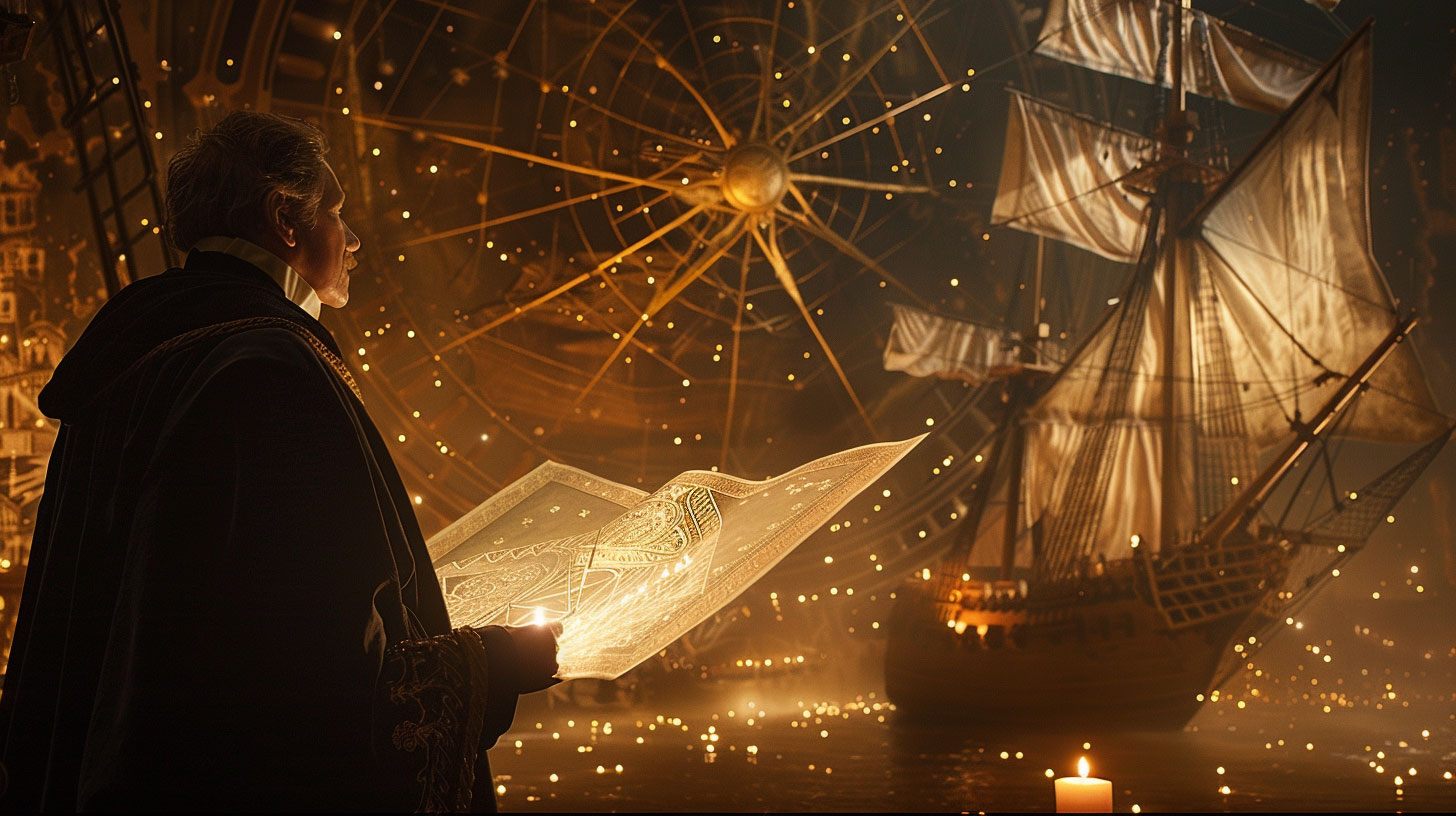
Hiram was the son of a widow from the Tribe of Dan, a lineage deeply intertwined with the sea-faring peoples of antiquity. This connection brings us to the myth of Danaus and Aegyptus, the story of the Tribe of Dan’s migration and their mastery of the pentaconter—the fifty-oared vessel. This is the biological and historical link to the Argo Navis, the first great ship to be immortalized in the stars. Newton argued that Chiron—the noble teacher of the healer Asclepius and the mentor to Jason—delineated the constellations specifically to guide this vessel. In this light, Chiron and Hiram represent the same Master Mason of the celestial and terrestrial spheres, providing the navigation charts for both the soul and the state.
The mathematical proof Newton utilized involved the Precession of the Equinoxes. By analyzing ancient records, Newton calculated that Chiron had placed the colures—the great circles of the celestial sphere—through the middle of the constellations of Aries, Cancer, Libra, and Capricorn. By measuring the shift of these stars from Chiron’s era to his own, Newton fixed a zero point for human history, placing the Argonautic expedition at precisely 939 BC. This date aligns perfectly with the construction of Solomon’s Temple, suggesting that the mapping of the heavens and the building of the Holy of Holies were a single, unified event.
This sacred map, however, contains hidden truths that have been obscured by time. The constellation Argo Navis, once the largest in the sky, was eventually broken apart, much like the unified wisdom of the ancient world. Similarly, Ophiuchus, the Serpent Bearer—the celestial representation of Chiron’s student, Asclepius—remains the thirteenth sign, often omitted from the common zodiac. These hidden figures correlate to the story of Orion and Osiris, the hunters and kings who are slain only to be resurrected as celestial markers. Newton saw these myths not as a sophisticated method of preserving the identity of the stars across cataclysms.
Newton’s fascination with this chronology was driven by a desire to know the day and the hour. By layering the measurements of the Temple over the timeline of the Argonauts and the prophecies of the ancient world, he arrived at two striking thresholds: 2035 and 2060. He viewed the mid-2030s as a pre-cursor period—a biological and social stripping of the earth as the old systems fail to maintain their alignment with the celestial standard. This aligns with his 2060 calculation, which he viewed as the restoration of a sacred order, the moment when the last shall be first.
To understand the weight of these dates, we must look at the biological signature within the vessel of man. Newton’s Temple and the Great Year are governed by the Phi Ratio, the divine proportion of one point six one eight. This universal code is etched into our DNA and the very proportions of the human body. Just as the base of a pyramid represents stability, our biological alignment with this ratio allows for the efficient flow of life force energy. The twelve foundations of the New Jerusalem find their geometric counterpart in the dodecahedron, a twelve-sided shape that Plato believed represented the entire universe. This twelve-fold symmetry is the bridge between human consciousness and the unlimited possibilities of the cosmos.
Why must we take heed of these profound deductions today? As we witness the stripping and polluting of the earth, Newton’s work serves as a warning of the mathematical limit. Newton understood that the constant of precession—the shift of one degree every seventy-two years—governs the Great Year of twenty-five thousand, nine hundred and twenty years. Just as Jason needed Chiron’s stars to survive the voyage, and Solomon needed Hiram’s craftsmanship to anchor the Divine on earth, humanity needs this celestial chart to navigate the transition between worlds. We are currently the Argonauts of a dying era, sailing in a vessel that has forgotten its origin. To take heed of Newton’s chronology is to recognize that we are part of a grand architecture that demands our respect, our service, and a return to the first celestial chart.
– – – – –
Appendix: The Precession Calculation and the Phi Constant
Newton observed that the Greeks placed the Vernal Equinox exactly at the fifteenth degree of Aries during Chiron’s time. By the year sixteen hundred and ninety, Newton noted the Equinox had shifted back to the sixth degree of Pisces. This shift of thirty-six point five degrees, when multiplied by the constant of seventy-two years per degree, reveals a span of two thousand, six hundred and twenty-eight years. Subtracting this from his current era led Newton back to nine hundred and thirty-nine BC, the year the Temple and the Chart became one. This alignment is further solidified by the Phi Ratio of one point six one eight, which governs the growth of the human body and the resonance of the heart, proving that the architecture of the stars and the architecture of the soul are one.