An interactive cabinet of instruments
The Atlas of Measures
Map the measured Earth. Square the circle. Weigh a word, grow a seed head and hear the ratios. Here are nine instruments for exploring the numbers of LUFT with your own hands, and every one shows its working.
The Measured Earth
A hand-inked map of the ancient world’s great measured places, from Giza and Jerusalem to Stonehenge, Teotihuacan and Chaco Canyon. Tap any two and the instrument measures the arc between them along the curve of the Earth.
Distances follow the great circle on a sphere of mean radius 3,958.8 miles. The tropics sit at 23½°, the same tilt that turns the Great Year. “From my location” uses your browser’s location only to draw the line; nothing is stored. Coastlines: Natural Earth.
The Squared Circle
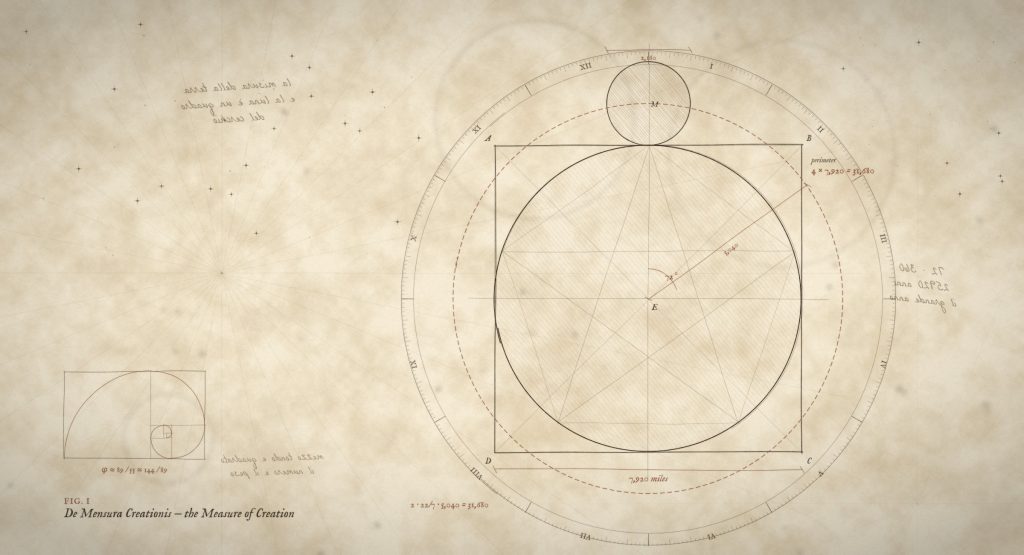
Draw a square around the Earth: its perimeter is 31,680 miles. Rest the Moon on top and draw a circle through its centre. With the builder’s π of 22/7, that circle is exactly 31,680 miles too. Change π, or the size of the Moon, and watch the match appear or break.
The Great Year
The Earth’s axis wobbles like a slowing top, carrying the spring equinox backwards through the constellations. At one degree in 72 years the circle takes 25,920 years to close. Drag through history, or enter your birth year to see how far the heavens have turned in your lifetime.
Light’s Journey
Send a beam to the Moon, to the Sun, or once around the Earth. Measured, sunlight takes about 499 seconds. In LUFT’s harmonic measure it takes exactly 500, and 500 is the value of the Greek letter Φ. Watch in real time if you have eight minutes.
The Gematria Abacus
In Hebrew and Koine Greek every letter is also a number, so every word has a weight. Tap the letters, paste a word or choose one below. Λόγος, the Word, weighs 373. Κύριος Ἰησοῦς Χριστός weighs 3,168.
The Seed-Head Garden
A sunflower sets each new seed a fixed turn from the last. At 137.5°, the golden angle, the seeds pack perfectly and Fibonacci spirals appear. Nudge the angle by a single degree and the order falls apart.
The Monochord & the Breath
Pythagoras heard number in a single string: halve it for the octave, take two thirds for the fifth. Tap to hear each ratio on a ground tone of 432 or 440. Then breathe with LUFT’s pulse, 72 breaths in five minutes.
The breath pulse
Seventy-two breaths
At rest, an adult breathes about twelve to twenty times a minute. LUFT takes 72 breaths in five minutes, a little over fourteen a minute, as its pulse, the same 72 that turns the sky one degree. “And the LORD God … breathed into his nostrils the breath of life” (Genesis 2:7).
This pacer is a gentle rhythm to follow, not a breathing exercise or medical advice. Stop if you feel uncomfortable.
The Balance
How close are LUFT’s harmonic numbers to modern measurement? Each beam weighs one constant: the further right the marker sits, the larger the gap. Jesse calls the remainder “1.0 friction”. Here is the gap itself, number by number, so you can judge.
Audit a Number
Jesse calls his method forensic accounting: totalling the ledger of the Word against the ledger of the World. Enter any whole number to see its prime factors, how many divisors it has, whether it divides by LUFT’s keys, and whether it already appears in the ledger.
Keep exploring
Every instrument has a paper behind it.
See the full working on The Measures, read the SOD papers behind the numbers, or ask the Guide about anything you measured here.