The evidence, scale by scale
The Measures
Move a magnifying glass across creation: from the turning heavens to the Earth, into the Temple, through the letters of Scripture and into a single living thing. Each entry shows its working. Where a measured value and a harmonic value differ, both are given.
Number in space and time
The Heavens
The slowest clock we know is the wobble of the Earth’s axis. It carries the equinoxes backwards through the constellations by about one degree in a human lifetime. Ancient astronomy fixed that rate at 72 years, and from it builds the Great Year.
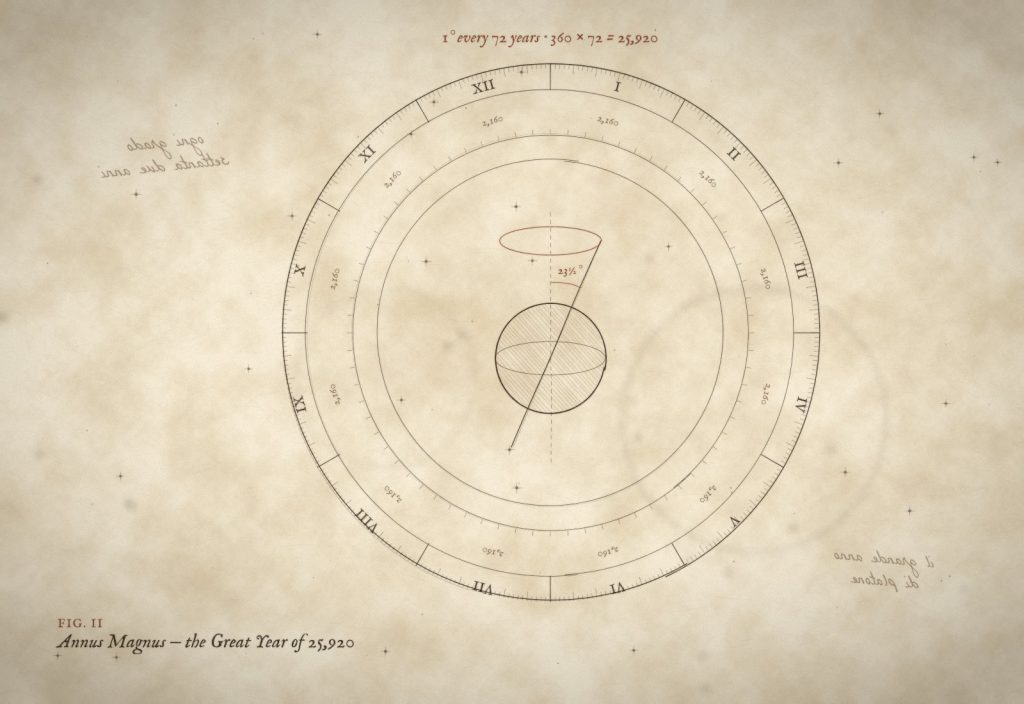
The equinox shifts one degree against the stars in about 72 years.
One full turn of the equinoxes: 360 degrees at 72 years each. Also 60 × 432 and 12 ages × 2,160.
A twelfth of the Great Year: the time the equinox spends in one sign. It is also the Moon’s diameter in miles.
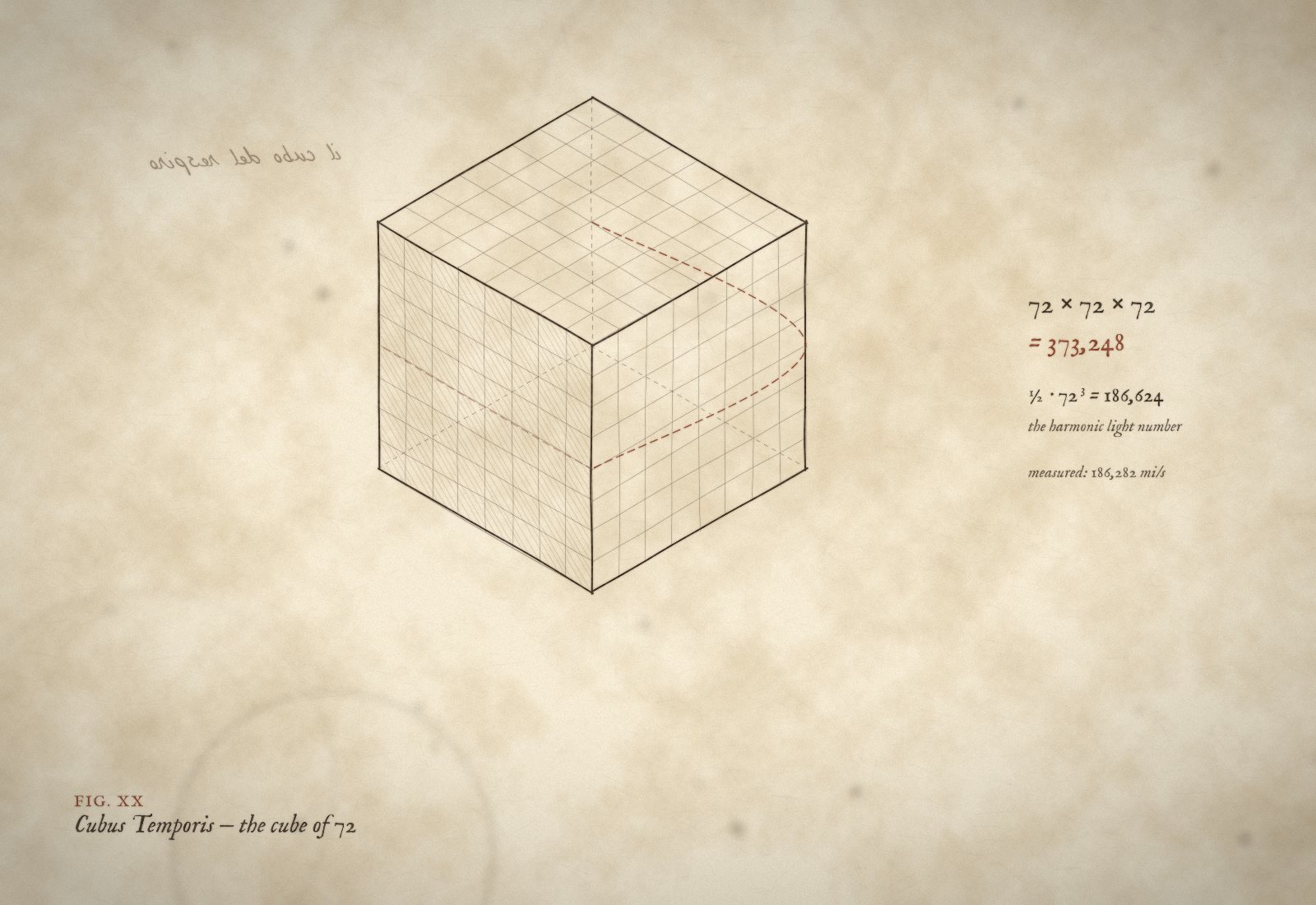
Half of 72³, and also 432². Jesse reads the gap from measured light speed, about 0.18%, as “1.0 friction”.
At the harmonic speed, light crosses 93,312,000 miles in exactly 500 seconds. 500 is the value of Φ in Greek numerals.
The Sun’s diameter is close to 864,000 miles, and 864 = 2 × 432 = 12 × 72. There are 86,400 seconds in a day.
Number in space
The Earth
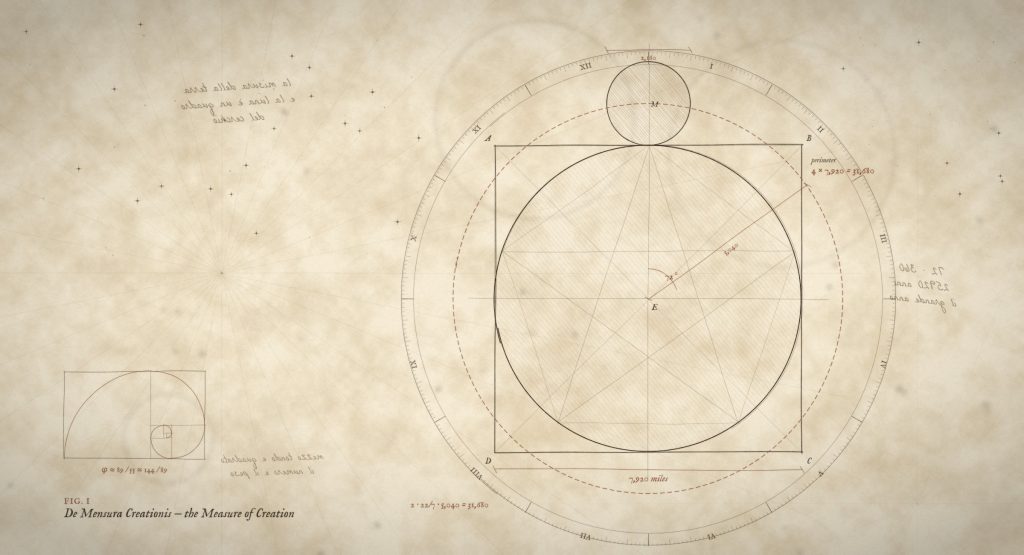
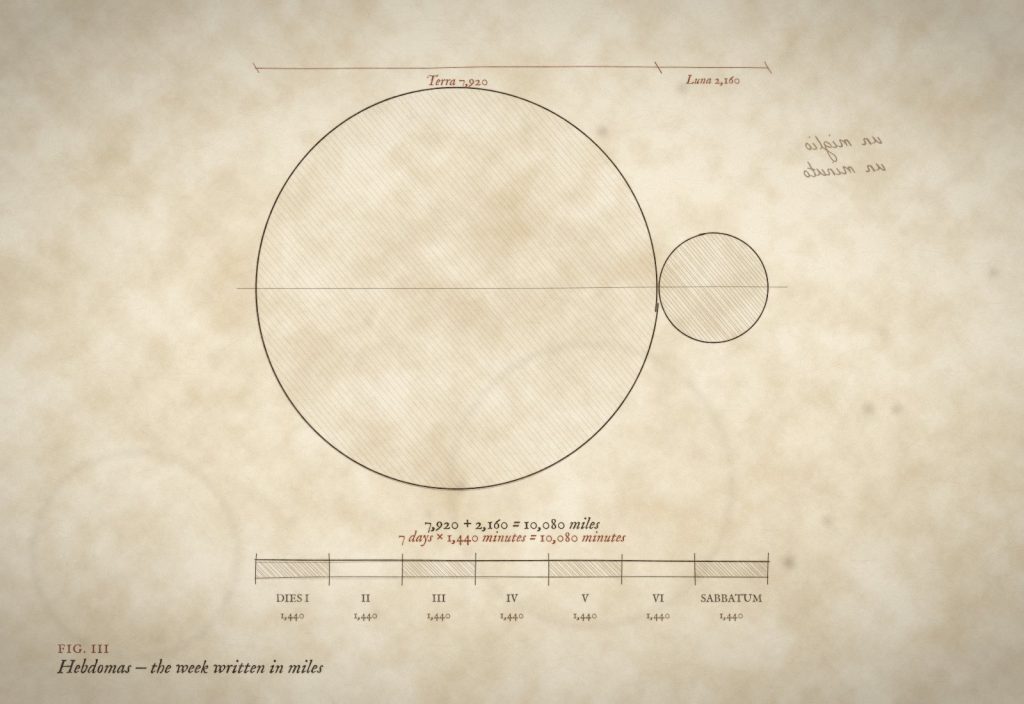
Put the Earth and the Moon side by side and their diameters, 7,920 and 2,160 miles, add to 10,080. That is the number of minutes in a week. Draw a square around the Earth and its perimeter is 31,680 miles, ten times the value of the Name.
The traditional mean diameter in miles: the product of four consecutive numbers, and the breath number carried by 1.1.
The two diameters together equal the minutes in a week. Jesse’s reading: one mile of diameter for each minute of time.
The square around the Earth has perimeter 31,680. A circle through the Moon’s centre, radius 5,040, has the same length when π = 22/7.
3,960 + 1,080. It is also 1 × 2 × 3 × 4 × 5 × 6 × 7, the number Plato chose for his ideal city in the Laws.
Feet in a mile. The Earth’s 7,920 miles is exactly one and a half times 5,280. In Jesse’s Old Testament audit, 4,800,000 × 1.1 = 5,280,000.
Measured with π = 864/275, the Earth’s circumference ends cleanly instead of trailing decimals. It differs from the π result by under 0.01%.
The pattern shown on the mountain
The Temple
Moses was told to build “after their pattern, which was shewed thee in the mount” (Exodus 25:40). In LUFT the Tabernacle and Solomon’s Temple are scale models of the cosmos. Measured with the 18-inch cubit, their rooms resolve into 72, 432 and the light number.
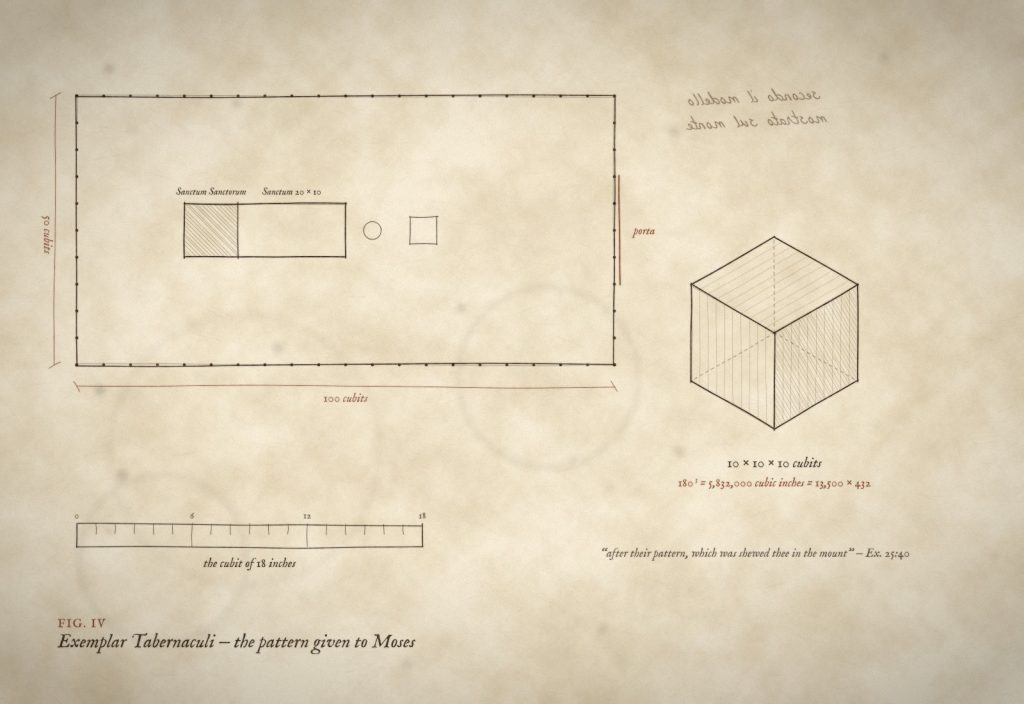
The cubit LUFT uses for the sanctuary. Scholarly estimates of ancient cubits range from about 17.5 to 20.6 inches.
A perfect cube of ten cubits: 180 inches a side. Its volume divides by both 72 and 432, and 18³ = 5,832 is exactly 1/64 of 72³.
Twenty cubits long: 360 inches, the degrees of a circle.
From 1 Kings 6: 720 × 360 × 540 inches. Its volume divides exactly by the harmonic light number.
Two and a half cubits by one and a half: a Fibonacci step on the way to the golden ratio.
The city of Revelation 21 measures 12,000 furlongs. In Jesse’s audit the Greek New Testament totals 63,360,000, which is 12,000 miles of feet.
Every letter a number
The Word
Biblical Hebrew and Koine Greek are alphanumeric: every letter is also a number, so every word has a value. Jesse calls the method “forensic accounting”: totalling the ledger of the Word to see whether it matches the ledger of the World.
The book-length totals (Torah, Psalms, New Testament) come from Jesse’s own letter-by-letter audits of specific printed editions. The method is described in “The Mathematical Integration of Geodetic Constants and Biblical Gematria”.
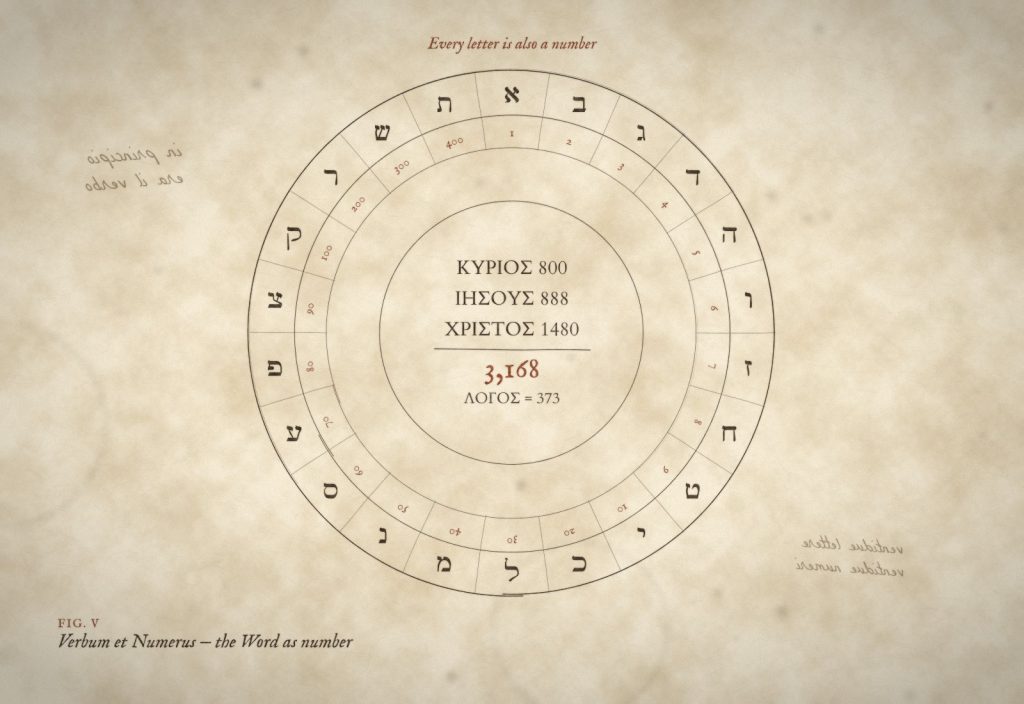
Κύριος (800) + Ἰησοῦς (888) + Χριστός (1,480). Multiplied by ten it is the perimeter of the square around the Earth.
Ἰησοῦς: iota 10, eta 8, sigma 200, omicron 70, upsilon 400, sigma 200.
λόγος, “Word”: lambda 30, omicron 70, gamma 3, omicron 70, sigma 200.
Rabbinic tradition counts 248 limbs in the human body, matching the 248 positive commandments. Jesse pairs it with Logos: written together, 373 and 248 make 373,248, which is 72³.
The divine name of Exodus 3:14: aleph 1, he 5, yod 10, he 5.
Jesse’s letter-by-letter audit of the 150 Psalms. One hundredth of it is the harmonic speed of light.
Number in living things
Life
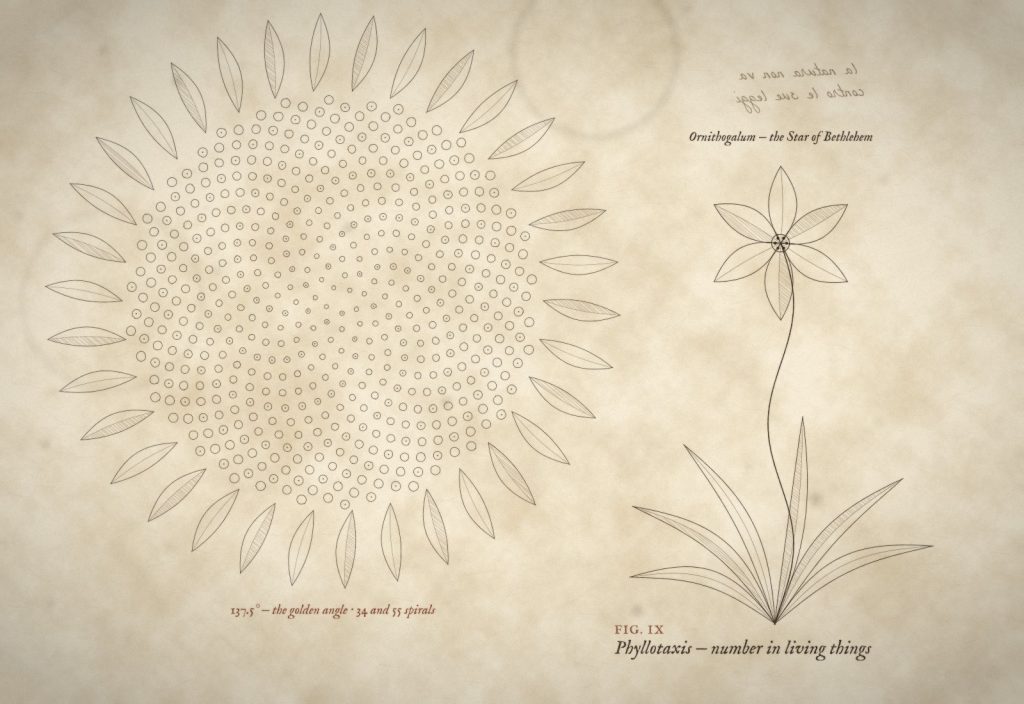
At the smallest scale the lens finds breath and growth. A resting body breathes about 72 times in five minutes, and a resting heart is often given as 72 beats a minute. The seeds of a flower head pack themselves in spirals that count the Fibonacci numbers, turning by the golden angle.
About 72 breaths in five minutes at rest, roughly 14 a minute. In Genesis 2:7 it is the breath of life that animates the form.
Leaves and seeds set 137.5° apart never line up exactly, so they pack in interlocking spirals of 21 and 34, 34 and 55, or 55 and 89.
The proportion of growth. Fibonacci ratios step toward it from either side without ever drifting.
The twelfth Fibonacci number is twice 72. The tenth, 55, gives the bridge: 55/50 = 1.1.
The pentagon’s inner angle. Its outer and central angle, 72°, governs the five-fold symmetry of many flowers and fruit.
Successive Fibonacci numbers (3, 5, 8, 13…) give the counts of petals and spirals found throughout the plant kingdom.
The hidden order beneath
Number itself
Below every scale lies number itself. The famous constants of mathematics have whole-number approximations close enough to have served builders for millennia, and modern mathematics keeps finding exceptional order where randomness was expected.
The classical whole-number circle, accurate to 0.04%. LUFT also uses 864/275 (within 0.007%) and 355/113 (accurate to six decimal places).
Riemann’s conjecture of 1859: every nontrivial zero of the zeta function has real part ½. A proof was announced on November 20, 2026 and is under review.
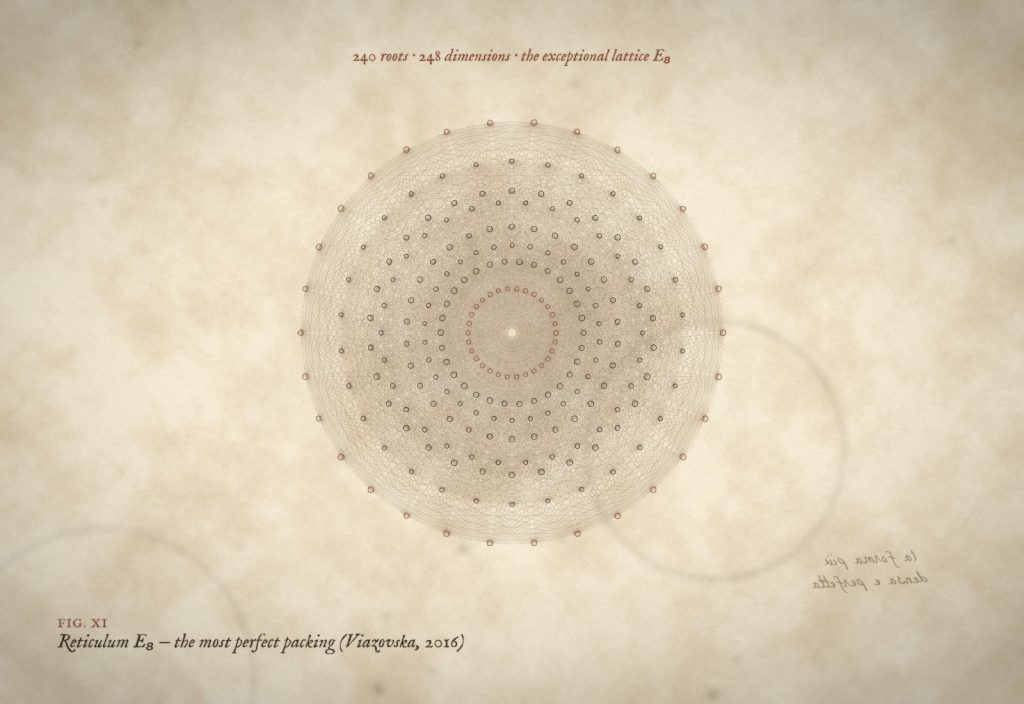
The exceptional symmetry of 248 dimensions, with 240 roots. In 2016 Maryna Viazovska proved its lattice the densest packing of spheres in eight dimensions.
The count of divisors of 37,324,800, which is 8,640 × 4,320 and also 200 × 186,624. Jesse connects it with John Dee’s Monas Hieroglyphica.
The ratio of 11 to 10. It appears as 660/600, 55/50 and 79.2/72, and it carries 72 into 7,920.
Jesse’s estimate of the odds that so many independent alignments arose by accident: at least one in 10¹⁵, and possibly one in 10³⁰.
A note on method
How to read these numbers
LUFT’s case is cumulative. No single number proves design. The argument is that the same small set of numbers keeps returning across fields that have nothing to do with one another: astronomy, geodesy, the length of a week, the letters of Scripture, the growth of a flower.
Many of LUFT’s values are traditional or rounded: 7,920 miles, 72 years a degree, 864,000 miles for the Sun. Where modern measurement differs, the measured figure is printed beside the harmonic one. In Jesse’s framework that gap is the “1.0 friction” the theory sets out to explain. You can check every figure here against the sources on the Resources page, and ask the Guide to show its working for any of them.
See the numbers move
Measure it yourself.
Every scale on this page has an instrument in the Atlas of Measures. Drag the Great Year through history, send light to the Sun, grow a seed head at the golden angle and weigh each harmonic number against its measured value.
- IThe Measured EarthAn inked map of the ancient world
- IIThe Squared CircleThe Earth, the Moon and 22/7
- IIIThe Great YearSeventy-two years a degree
- IVLight’s JourneyFive hundred seconds from the Sun
- VThe Gematria AbacusWords that are also numbers
- VIThe Seed-Head GardenThe golden angle at work
- VIIThe Monochord & the BreathRatios you can hear
- VIIIThe BalanceHarmonic beside measured
- IXAudit a NumberJesse’s forensic accounting